FIFA World Cup 2026 · Round of 16
 Brazil
1–2
 Norway
Solbakken's structure, Haaland's ten minutes, and the night Ancelotti's Brazil fell.
BrazilNorway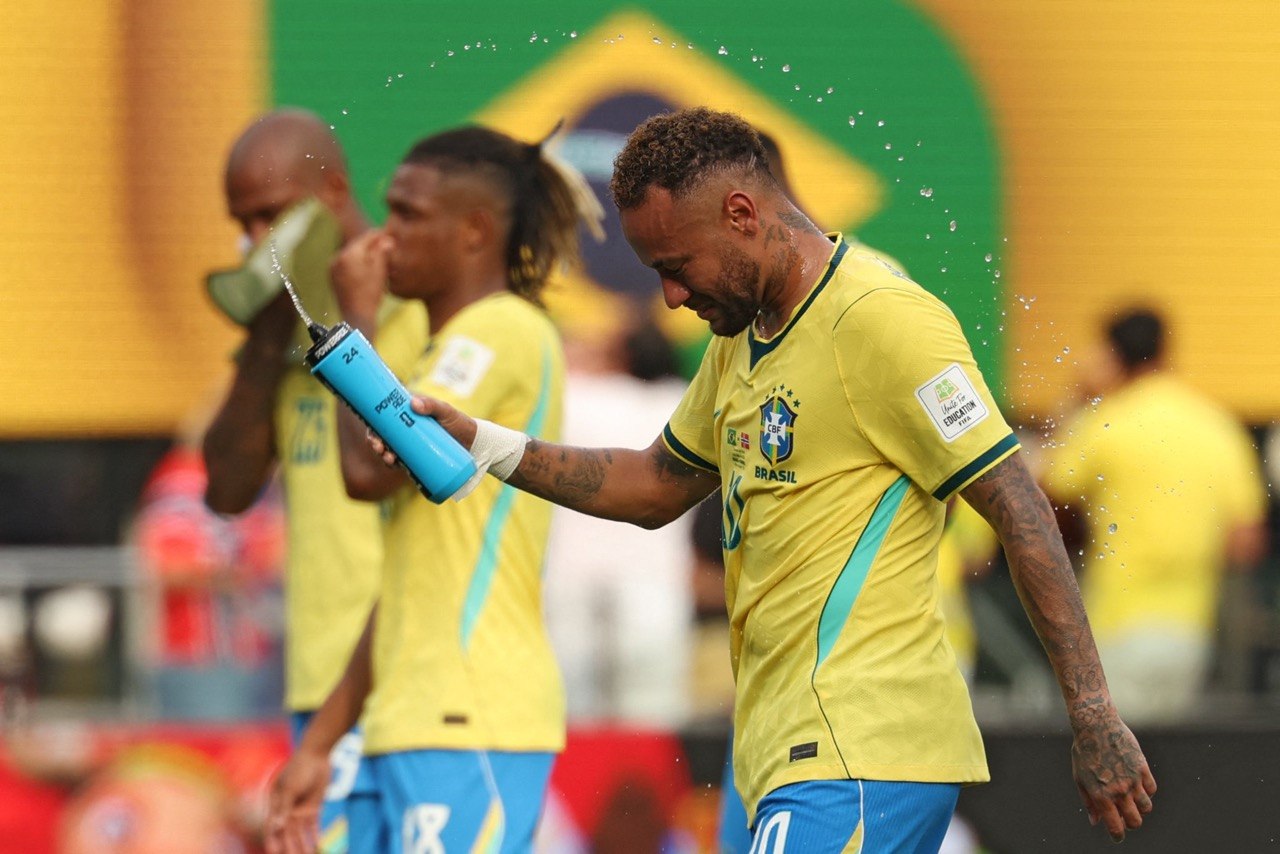
For seventy-eight minutes, this looked like a game Brazil would find a way to win — not by controlling it, but by punishing a patient Norway on the counter, with two penalties that should have settled it. Then a header nobody picked up, a lay-off nobody expected, and a stoppage-time penalty that arrived four minutes too late told the real story: a handful of half-chances with no defensive spine behind them is just noise before the final whistle.
This is the tale of how Norway's patience and Erling Haaland's ten second-half minutes turned a game Brazil should have won into a Round of 16 exit — built on three themes: Brazil's passive, counter-reliant 4-4-2, Norway's morphing possession structure that controlled the ball all night, and the individual moment in the 79th minute that Gabriel Magalhães will want back.
Carlo Ancelotti set Brazil up in a 4-4-2 that behaved like a 4-2-4 in possession and a 2-3-5 in the final third. Douglas Santos pushed high to combine with Bruno Guimarães down the left — the pass network's busiest connection all night. Casemiro and Guimarães split double-pivot duties; Rayan and Martinelli provided width and pressing intensity, while Cunha and Vinícius led the line, Vinícius drifting to combine but often isolated from a congested midfield. Ståle Solbakken's Norway lined up in a 4-3-3 that rarely stayed still — Ødegaard, Berge and Patrick Berg rotating through 4-2-4, 3-2-5, 3-1-6 and 4-1-5 shapes, with Ryerson and Wolfe overlapping from full-back as the connecting thread, all protected by a diamond press that split Brazil's pivot.
| Team | Base | In possession | Tactical focus |
|---|---|---|---|
| Brazil | 4-4-2 | 4-2-4 / 2-3-5 | Counter-reliant low block; left-sided overload via Santos & Guimarães |
| Norway | 4-3-3 | 3-2-5 / 3-1-6 | High rotation led by Ødegaard; overlapping full-backs from deep |
The changes reshaped both sides. At half-time Solbakken pulled Sørloth and Nusa for Andreas Schjelderup and Oscar Bobb — the single most decisive substitution of the match. Ancelotti replied at 58 with Endrick for Cunha, then a double change at 67 sent on Danilo Santos (the Botafogo midfielder, not the starting full-back of the same name) and Neymar for Martinelli and Rayan, stripping out his two most intense pressers. Éderson replaced Guimarães at 79 — the same minute Haaland opened the scoring.
Brazil's numbers look aggressive until you read them properly: 14 shots and 33 touches in the Norway box, but a 2.61 xG flattered by two penalties — in open play they mustered just 1.04, barely ahead of Norway's 1.05. And the mechanism was never a high press. Brazil sat in a zonal mid-to-low block, with Cunha and Vinícius pressing lightly up front and no numbers committed behind them, then springing Cunha or Guimarães wide on the counter whenever they turned it over. That pattern produced Brazil's best chance inside the first quarter of an hour: a sharp Guimarães pass found Martinelli, who slipped it into Cunha, and Cunha's run drew a clumsy challenge from Ajer for a penalty. Guimarães, having created it himself, took the responsibility — and was well saved by Nyland diving to his right. No teammate reset him afterward; his numbers cratered from there, and a case exists that he should never have played the final half hour.
The same low block that kept Brazil compact made them fragile the moment it slipped. In their mid-to-low block, Vinícius Jr. simply did not track back, and while his end product stayed sharp — 7.4 on the night, a rating that undersells his isolation from a congested midfield — the lack of defensive instinct from an attacker of his stature left gaps Norway would eventually find. Only Rayan and Martinelli pressed with consistent intensity, and both were gone by the 67th minute — exactly when Brazil's resistance began to fold.
Norway held 66 percent possession and completed 618 of 681 passes at 91 percent — a rhythm of control marked by an almost cold composure, never frantic, because it was never meant to be. Their zonal 4-5-1 rarely engaged man-to-man in advanced areas, deliberately conceding Brazil's extra man in central buildup while isolating whichever Brazilian was found on the far side. It trades territory for chance suppression, and it explains the shot map: Brazil's 14 attempts produced an underwhelming 0.19 xG each, scattered wide of true clarity, while Norway's 9 attempts — funneled through the right channel, where 47 percent of their attacking play flowed — were sharper and more central. And the possession was a defensive weapon in its own right: every Norwegian pass was another second Vinícius and Cunha spent watching the ball instead of running at space, smothering the quick transitions that were Brazil's only real route to goal. The goals were the structure paying off.
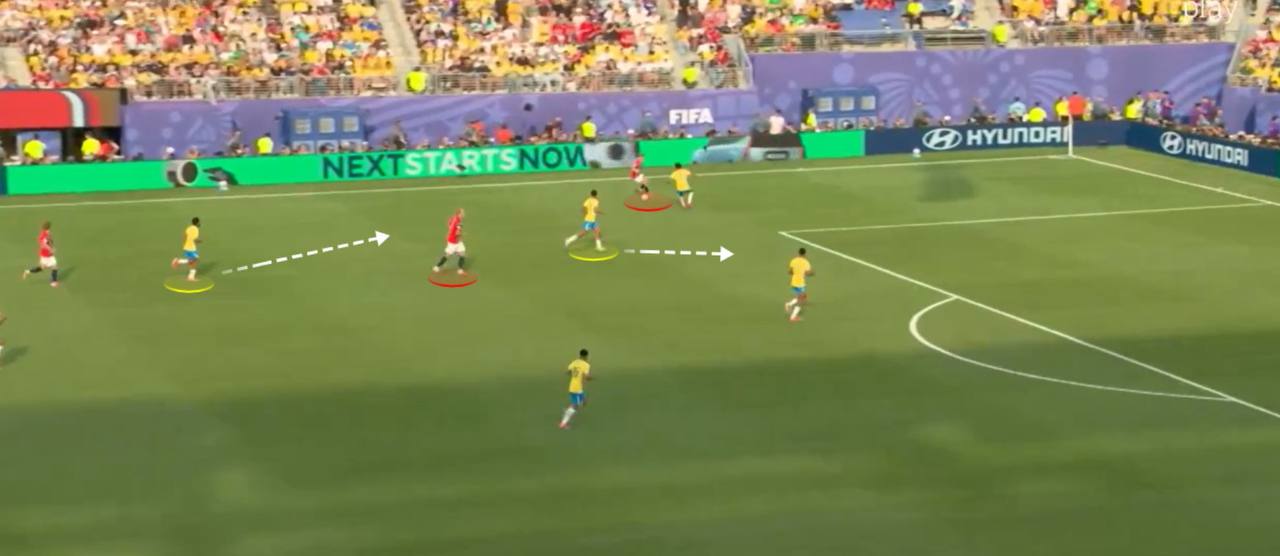
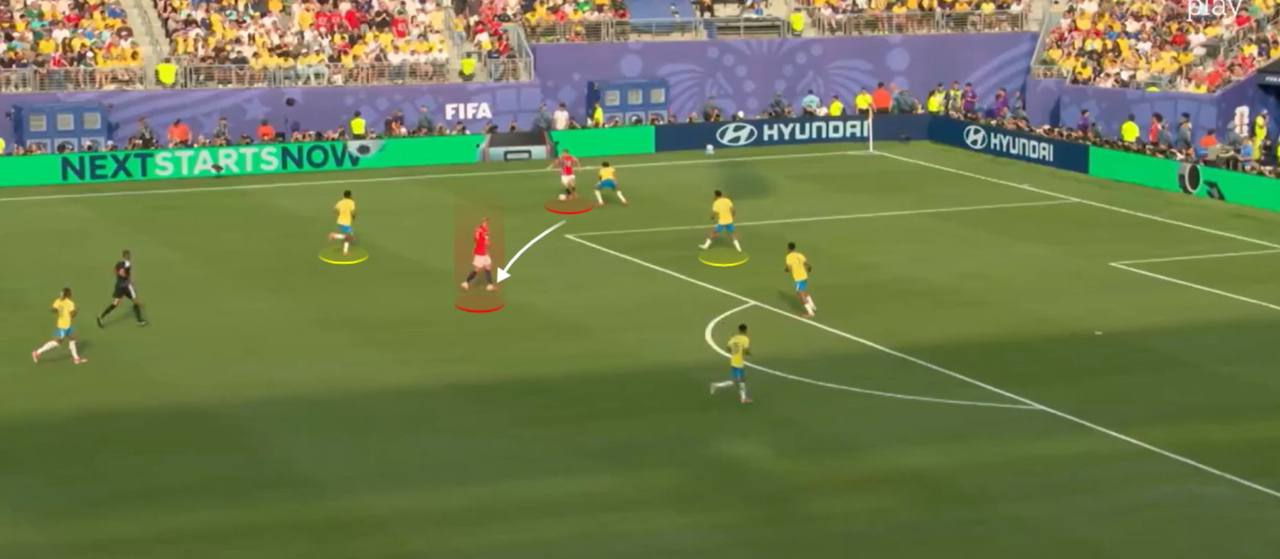
Two goals, one mechanism: patient buildup exploiting a single lapse, then Haaland's movement finishing what the structure created — the second a stunning 0.04 xG strike, a four-percent chance dispatched with a game still in the balance. Brazil's stoppage-time reply came from the other direction entirely — Casemiro caught in the face by a Norway defender, a stonewall penalty, and Neymar converting calmly in the tenth minute of added time. It was Brazil's second penalty of the match and their only goal, but it altered nothing.
The game turned in the 79th minute — not because Haaland's header was spectacular, but because of what it represented: the moment a passive, deep-sitting night finally came due. Gabriel losing Haaland wasn't really an isolated error so much as the product of a team that had defended deep for seventy-eight minutes without ever controlling the game — one lapse in concentration was all a patient Norway needed. Once Norway led, their patient structure no longer needed to force anything — they simply managed the minutes, which they did by scoring again almost immediately.
Solbakken's half-time double change was the tactical masterstroke of the match. Schjelderup (8.3, two assists) and Bobb brought fresher legs and sharper movement against tiring Brazilian markers, directly authoring both goals. Ancelotti's response came late and reactively: Endrick for Cunha at 58 was meant to inject a finisher — but the finisher spurned the game's clearest chance himself, firing wide with only Nyland to beat, and made little further impact. Withdrawing Rayan and Martinelli together at 67 — his two hardest workers — traded them for attacking flair at precisely the wrong moment, and Brazil lost what little pressing it had left. It was no accident that twelve minutes later Ødegaard — suddenly unhurried — dropped into the pocket he'd been denied all night and orchestrated the opening goal.
The difference between the sides — two goals from ten decisive minutes, a header born of superior movement and a finish that showed composure most strikers don't have with a game still level.
Transformed the match the instant he entered, supplying both assists and giving Norway a right-sided outlet Brazil never solved.
Outstanding in goal — four saves, one of them Bruno Guimarães's first-half penalty, that kept Brazil scoreless from open play; his positioning also helped send Endrick's clearest sight of goal flashing wide with the game still level.
Marshalled Norway's midfield with a defensive discipline that let Ødegaard (7.3 — quiet early, sharper once he dropped deeper) dictate rhythm without being overrun.
Their most dangerous individual outlet even while isolated from midfield support — but no help off the ball.
Controlled tempo well and won the game's decisive penalty in the dying seconds.
Three saves; kept the score respectable against a Norway side generating 1.05 xG from just nine attempts.
Scored Brazil's goal from the spot but picked up a needless late yellow.
An ordinary night — not directly at fault for either goal, but unable to stamp his authority on a defense that lost its shape when it mattered.
This was a match won by structure over spectacle. Brazil had the two penalties and the sharper counters and still lost, because sitting deep without the ball only works if the back line holds its shape at the one moment that matters — and Ancelotti's did not. The expected-points model still leaned Brazil's way — 2.22 to Norway's 0.60 — a measure of the chances, and the two penalties, they failed to make count.
For Brazil, the exit raises real questions about balance under Ancelotti — talent alone cannot paper over a rest defense this porous at a World Cup. For Norway, Haaland's brilliance and Solbakken's tactical nerve at half-time have booked a quarterfinal spot that, on this evidence, they have more than earned.